The 10 greatest changes of the past 1,000 years | Books | theguardian.com

Château de Loches
My castle is not your castle … the keep of Loches castle, shown here in a detail from Emmanuel Lansyer’s 1891 painting, was built in the 11th century. Photograph: World History Archive/Alamy

11th century: Castles

Most people think of castles as representative of conflict. However, they should be seen as bastions of peace as much as war. In 1000 there were very few castles in Europe – and none in England. This absence of local defences meant that lands were relatively easy to conquer – William the Conqueror’s invasion of England was greatly assisted by the lack of castles here. Over the 11th century, all across Europe, lords built defensive structures to defend them and their land. It thus became much harder for kings to simply conquer their neighbours. In this way, lords tightened their grip on their estates, and their masters started to think of themselves as kings of territories, not of tribes. Political leaders were thus bound to defend their borders – and govern everyone within those borders, not just their own people. That’s a pretty enormous change by anyone’s standards.

12th century: Law and order

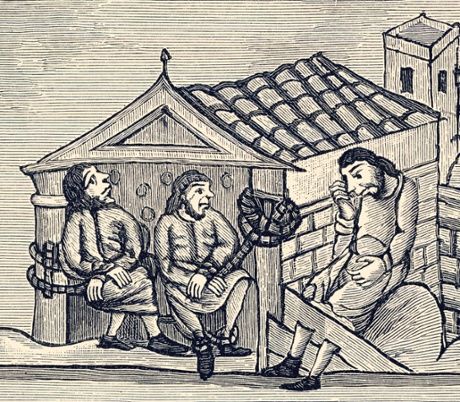
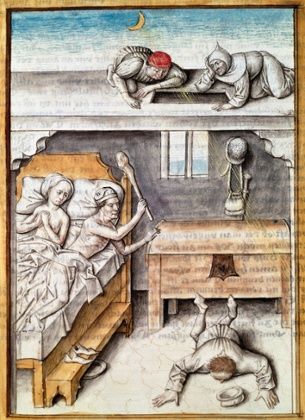
A 12th-century illustration of men in the stocks
Banged up ... detail from a 12th-century illustration of men in the stocks. Photograph: Culture Club/Getty

If you consider visiting a foreign country, one of the most important aspects you bear in mind is how safe you will be while you are there. Indeed, probably no other factor deters people from visiting a place as much as an absence of law and order. So it follows that the introduction of the systematic application of law and order marks quite a turning point in European history. This happened through the compilation of law books, the development of jurisprudence, and, in England, the development of “justices in eyre" – the forerunners of circuit judges – together with the establishment of trial by jury.

13th century: Markets

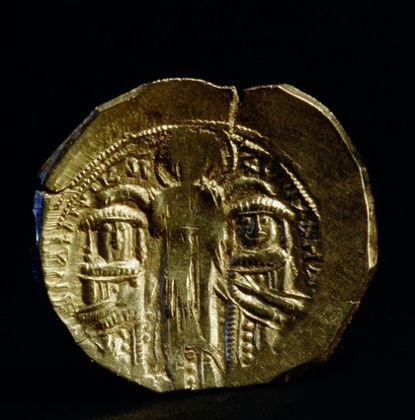
A 13th-century gold coin
Market value ... a 13th-century gold coin. Photograph: Heritage Image/Alamy

As is well known, money has existed for thousands of years. However, that doesn’t mean it has always served the same function as it does today. At the start of the 13th century not many people used money in England. The vast majority lived in the country and bartered for the things that they could not make for themselves. Lords commanded the time of their peasants and allowed them to farm a few acres in return. The only people who regularly handled silver pennies were the inhabitants of market towns – and there were only 300 of those (and some had fewer than 500 people). However, over the course of the 13th century another 1,400 markets were founded in England. European countries saw a similar quadrupling of the number of towns. Not all of these new foundations succeeded but many did. The whole of christendom shifted to a more mercantile economy as you simply cannot operate a barter system efficiently in a marketplace. By 1300, several countries had begun minting large-denomination coins in gold, and credit was available from Italian banking companies, which had branches across the continent.

14th century: Plague

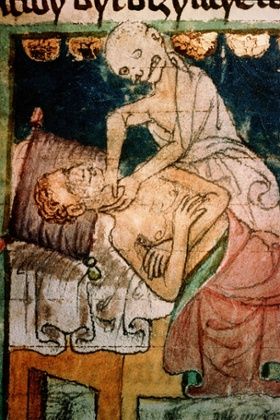
A contemporary illustration of Death strangling a victim of the plague
The greatest disaster to befall mankind ... a contemporary illustration of death strangling a victim of the plague. Photograph: Heritage Image/Alamy

The greatest disaster to befall mankind and the most important event in the history of the western world had absolutely nothing to do with technology. With roughly half the population of the country dying in the space of seven months, the mortality impact was about 200 times as great as that of the first world war. The socio-economic consequences were profound. The old feudal system was dealt a heavy blow as the paucity of survivors meant workers could charge more for their labour, and peasants could acquire assets and even set themselves up as manorial lords. Questions were raised about God’s relationship with mankind and the nature of disease – how could a benevolent deity kill so many innocent children? At the same time, people began to regard death in a new light, and the religious started to abase themselves, adopting a stance of abject humility in the eyes of God. Thus the plague not only killed people, it changed the ways people lived, as well as their expectations of death.


15th century: Columbus

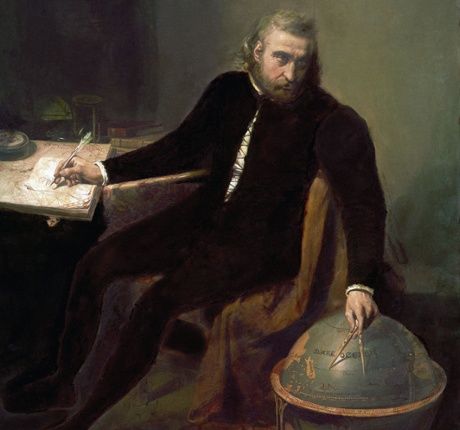
Detail from Emile Lassalle's 1839 portrait of Christopher Columbus
Expanding horizons ... detail from Emile Lassalle’s 1839 portrait of Christopher Columbus. Photograph: Famoso/Alamy

The most important relationship in human history is between mankind and the land. Basically, the more land you have, the more natural resources you have. Columbus thus stands as one of the most important figures in history. With a great fanfare of his own achievement, he showed Europeans the way to vast territories of which no one had previously dreamed. No new technology empowered him: the compass was already at least three centuries old by the time he discovered Hispaniola in 1492. It was rather socio-economic pressure that drove him – together with his own desire to become a wealthy landowner. The consequences go far further than Spanish being the second-most widely spoken language in the world today (after Chinese). Until 1492 most people had believed the ancient Roman and Greek writers had reached an epitome of knowledge. However, there is no reference to the American continents in Ptolemy or Strabo. People quickly realised that, if the ancient writers could have missed two whole continents, they might have misunderstood many other things too. The crossing of the Atlantic was thus one of the two or three biggest causes for the re-evaluation of received wisdom in the last thousand years.

16th century: The decline of personal violence

A 16th-century illustration of a homeowner thwarting a burglary
Greater certainty of finding the guilty party ... 16th-century illustration of a homeowner thwarting a burglary. Photograph: Leemage/Getty

The pre-industrial past was, by our standards, incredibly violent. In the middle ages, the murder rate in Oxford occasionally hit the same level as Dodge City at the height of the American gun-slinging wild west. But from 1500, the murder rates decreased rapidly, and not just in Oxford. In fact, across Europe, they more or less halved every 100 years, until they started to increase again in the late 20th century. The cause was better communication, through a massive increase in literacy and writing, allowing governments to act more regularly and with greater certainty of finding the guilty party. People started to think twice before drawing a knife in a brawl. Constables answering to the authorities pursued highwaymen and similar culprits far more rigorously than in previous centuries. As with many changes over past centuries, the development was so gradual that contemporaries did not comment on them; they also quickly took a safer society for granted. But that very thing – a safer society – is something not to be thrown away lightly.

17th century: The scientific revolution

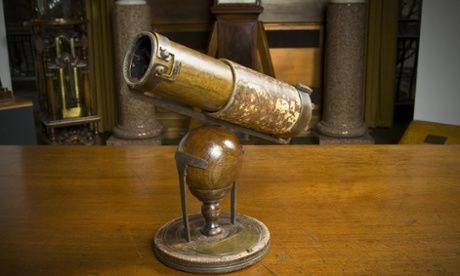
Reflecting telescope, built by Isaac Newton in 1668
Understanding the world ... the world’s first reflecting telescope, built by Isaac Newton in 1668. Photograph: Royal Society/PA

One thing that few people fully appreciate about the witchcraft craze that swept Europe in the late 16th and early 17th centuries is that it was not just a superstition. If someone you did not like died, and you were accused of their murder by witchcraft, it would have been of no use claiming that witchcraft does not exist, or that you did not believe in it. Witchcraft was recognised as existing in law – and to a greater or lesser extent, so were many superstitions. The 17th century saw many of these replaced by scientific theories. The old idea that the sun revolved around the Earth was finally disproved by Galileo. People facing life-threatening illnesses, who in 1600 had simply prayed to God for health, now chose to see a doctor. But the most important thing is that there was a widespread confidence in science. Only a handful of people could possibly have understood books such as Isaac Newton’s Philosophiae Naturalis Principia Mathematica, when it was published in 1687. But by 1700 people had a confidence that the foremost scientists did understand the world, even if they themselves did not, and that it was unnecessary to resort to superstitions to explain seemingly mysterious things.


18th century: The French Revolution

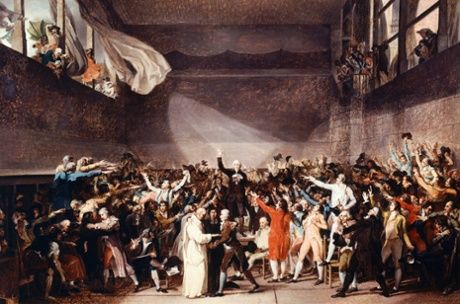
The Tennis Court Oath in Versailles by Jacques-Louis David
Liberté, Égalité, Fraternité ... The Tennis Court Oath in Versailles by Jacques-Louis David. Photograph: De Agostini/Getty

There is no doubt that the French Revolution of 1789 was THE revolution for the western world. It was the first testing of the idea, nationally, that men should be equal in the eyes of the law. It forced thinkers all across Europe to reassess the ideas of human rights, political equality, and the rights of women. Although many governments were initially cautious of encouraging change, without the French Revolution, it is difficult to see how the great social reforms of the 19th century – the abolition of slavery, universal education, the rights of women to act as independent property owners, public health, and the diminution of capital punishment – would have proceeded as they did.

19th century: Communications

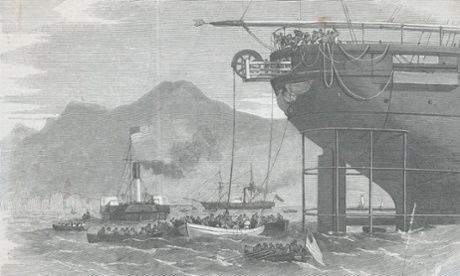
The first transatlantic telegraph cable is laid in 1858
‘Europe and America are united by telegraphy’ ... the first transatlantic telegraph cable is laid in 1858. Photograph: © Bettmann / Corbis

We think of the 20th century as undergoing a communications revolution. And for many people it has done: most of our great-grandfathers did not have a private phone in 1900 but about 40% of us had a mobile phone by 2000. But the real communications revolution lay in the 19th century – in 1900 you could send a telegram. In 1805, news of the Battle of Trafalgar (21 October) was delivered to the admiralty on 6 November. Just riding from Falmouth to London took Lieutenant Lapenotière 37 hours and 21 changes of horse. After the intercontinental telegraph cable was laid in 1872 it became possible to send a message to Australia immediately. The railways, telegraph and telephone made messaging much faster – in some cases almost instantaneous. This was just as significant as the modern communications revolution, if not more so. Governments trying to control their own countries and those overseas could now require that all important decisions be referred back to the capital; previously they had had to place trusted men in positions of responsibility all over the world – and hope for the best.

20th century: Invention of the future

Detail from Long Live the First Cosmonaut YA Gagarin! by Valentin Petrovich Viktorov
To infinity and beyond ... detail from Long Live the First Cosmonaut YA Gagarin! by Valentin Petrovich Viktorov (1961). Photograph: Heritage Images/Getty

There can be no doubt that technology hugely changed the ways in which we lived and died in the 20th century. However, it also masks changes that are arguably even more profound. In 1900 few people seriously considered the future. William Morris and a few socialists wrote utopian visions of the world they wanted to see, but there was little serious consideration of where we were going as a society. Today we predict almost everything: what the weather will be, what housing we will need, what our pensions will be worth, where we will dispose of our rubbish for the next 30 years and so on. The UN predicts world population levels up to the year 2300. Global warming reports are hot news. Novels about the future are 10 a penny. Newspapers and online newsfeeds are increasingly full of stories of what will happen, not what has happened. With limited resources on a limited planet, this is not a shift that is likely ever to change. In a thousand years or so, if society continues that long, the 20th century may well be viewed as the threshold when the modern world began – when humanity started to consider the future as well as the present and the past.

Centuries of Change by Ian Mortimer is published by Bodley Head (£20)

Guardian book club

Get the Guardian book club email

Hosted by John Mullan, be the first to find out about forthcoming events and featured authors.

Sign up for the Guardian book club email
 
 
http://www.theguardian.com/books/2014/oct/30/10-greatest-changes-of-the-past-1000-years

thinkingfilm

Saturday, 19 October 2013


(Popular) Films as Philosophy: A ‘Wittgensteinian’ View(er)

 
By Rupert Read.

There has been a great deal of interest in recent years in the question of whether films can function as philosophical works, in other words, can films ‘do’ philosophy? This interest, however, seems to sooner or later inevitably founder on the following dilemma: Either the philosophical work done by films is paraphrasable, in which case ultimately the films in question are merely pretty or striking vehicles for philosophising which precedes them; or the philosophical work done by films is not paraphrasable, in which case it seems mysterious/dubious/systemically-obscure.
However, this dilemma, while in its own terms quite correct, rests, I submit, on an unjustified presumption. The presumption is that philosophical ‘work’ has to be understood (if it is to be worthwhile) as issuing in theses/theories/opinions. But there is another possibility, a possibility explored at greatest length in Wittgenstein’s philosophy: that philosophical work at its best is ‘therapeutic’, in very roughly the psychological sense of that word. Namely: that philosophy need not – and in fact should not – issue in any controversial theses or opinions, any theories, at all. Rather, it should work with a person's own presumptions, exposing them to awareness, and thus empowering them to autonomously acknowledge, justify, overcome, or transform them. It is this possibility, that the members of the thinkingfilm collective aim to explore together over the coming months and years.

My own co-edited collection Film as Philosophy: Essays on Cinema after Wittgenstein and Cavell (Palgrave, 2005, with Jerry Goodenough), and especially Phil Hutchinson’s and my essay in that collection, endeavoured in a preliminary way to develop the idea sketched above. In the present piece, I want to enter a little further into it, and into the following associated question: Is there a way to understand how some of the greatest popular films work in ways that transcend any heresies of paraphrase, transcend film theories that would subject films to their diktat, and empower the viewer to understand how the films in question can enact 'therapeutic' work upon and with the viewer? A difficulty facing the efforts to understand films as philosophical works has been their (in most cases) consistently ‘dialogical’ nature, the way that they offer different voices, and not just (as most philosophical prose works do) one voice: but this is a strength of these film-as-philosophy works - once they are understood as 'therapeutic' works.

Take films such as Apocalypto, the Lord of the Rings trilogy, Children of Men, Bergman’s Persona, Malick’s The Thin Red Line and The New World. Are these films simply disguised pieces of didacticism? Do they have a simple ‘message’, which they wrap in an emotive, elaborate, striking and pretty coating, to sugar the pill? (How could a film be a major philosophical/ethical/political work, unless it basically did this? But/or equally: how could a film be such a work if it did basically only this?)

I say not. I say that there are not only these alternatives: Instead, you (and I am speaking here primarily of film-makers; though also of film-critics) can offer up your thinking on film as an exploratory intervention designed to facilitate a 'therapeutic' process of thinking and feeling on the part of the viewer. The work - the philosophical work - is work that viewers have to do for themselves. Whatever the viewer can do for themselves, one should leave them to do for themselves…

And I submit, as the reader will have noted, that what I am suggesting is true of some of the most popular films of our time. These, and the reader's resistance to the outline case I wish to make for them here, will be my primary focus, in the present piece.

So: The Lord of the Rings film trilogy can if you wish (see below) be said to make a new philosophical ‘argument’, cutting across and beyond Descartes. But it doesn’t make this ‘argument’ in the abstract. It encourages you to experience it. In general terms: the film challenges you; you go into ‘dialogue’ with it. You go into therapy with it, much as this is the process of reading the Tractatus or the Philosophical Investigations with understanding.

Let me illustrate this point by setting out briefly how I ‘read’ the Lord of the Rings film trilogy:
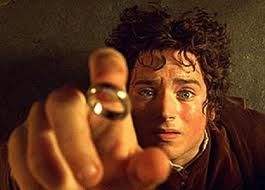


In Peter Jackson’s The Lord of the Rings, we see on the screen – we experience viscerally the point-of-view manifest in a pathological search for safety, for surety (most notably, we see this vividly in scenes in which one reaches for the Ring, for invisibility, for escape to a private realm that is one’s own, a realm where one can be lord and master). This desperate search for safety – for something that one can hold onto confidently – of Frodo et al results in one being ‘overpowered’ by an overwhelming dread at an ‘overwhelming’ watching, judging, heartless and destructive external agency. The search for safety results in one seemingly being confronted by absolute nemesis, with no expectation of being saved by a benevolent force – there is none as strong, or none that is willing, one is quickly convinced. That ‘God’ is onto me, and that ‘God’ is a malevolent demon; just that super-Cartesian possibility is, I am urging, lived out at the deep, dark heart of Lord of the Rings.

In fact, building on suggestions in my and Goodenough’s Film as Philosophy, and in my essay on The Lord of the Rings in my book Philosophy for Life (Contimuum, 2007), I would argue that Jackson’s analysis, building on and going beyond Tolkien’s, is far subtler and more psychologically-real than Descartes’s emotionless academic rendition of the mind ‘meditating’ upon the terrors of possible cosmic aloneness and the company one might surprisingly and regrettably find oneself keeping in that aloneness. For Jackson, the God-awful malign demon is not a self-standing ontic thing. Rather, to be God-powerful, it needs something to complete it. It needs you, or more specifically, your fear and addictive desire and weakness. It needs your desire for power, that corrupts, that takes you from others; it needs your self-fulfilling fear of ‘it’; it needs your weakness, that would hand the power over to ‘it’ in a doomed bid to lessen the grip upon you of dread. The malicious demon (in Jackson/Tolkien) depends on you. He is not all-powerful, without the One Ring that is in your power. You are not nothing beside Him; you are just pitifully small and vulnerable in comparison, as you toss on the sea of fate. He will only become all-powerful if you try to become him, or alternatively simply give him the power he seeks.
The rationale here, and it is a profound one, is this: If God/Satan/Sauron quite simply is all-powerful, then – paradoxically – your worries are significantly tempered. For there is then no quest, no chance of escape, nowhere to hide. One can give up worrying. The mind in search of absolute safety-certainty, the mind unused to not-worrying and unwilling to risk such a state, must then restlessly pass on from the assumption of one’s absolute abjection before God. If one is infinitely less than God, then one is to some extent relieved, even if God is malign: because at least there is then nothing more one can do. One can simply sit back, and wait to be annihilated or tortured etc., safe in the knowledge that there is no way out. Belief in an omnipotent God, even if the God has an Old Testament temper or much worse, is a means to the psychological security of not actually having to go on actively worrying and acting. The mind in search of absolute safety, the mind in search of any possible threats to it will quickly, restlessly, move on: the more worrying thought that comes to one next (a thought that is common in schizophreniform mental ‘disorder’, but that is never arrived at in Decartes’s meditations) is that perhaps one does still have a part to play, that one’s actions will be consequential, that what one does or thinks next could make things even worse. Paradoxically, there is something even worse than abjection before an all-powerful malevolent demon: namely, the threat of a less than all-powerful malevolent demon whose power and action depends on you, on what you do and think. The ceaseless, hungry, terrified motion of schizoid thought is right here: Jackson correctly identifies and powerfully depicts a potentially-self-fulfilling threat to thought and to one’s very sense of identity more profound than – and a logical extension of – that which Descartes set out for us. This then is literature/film as philosophy, with a vengeance: Jackson’s Tolkien has taken us somewhere philosophically new, somewhere undreamt of in Cartesian philosophy.
This then is the case for seeing the Lord of the Rings as a subtler and nastier moral threat than Descartes’s demon, and thus for seeing Jackson/Tolkien as offering a philosophical corrective to Descartes, filling in the gaps in his presentation of what it would actually mean to imagine a malign demon of infinite or (better) of great power. The really disturbing, the more deeply psychologically-challenging notion, the clear and distinct idea that can unworld one, is that ‘malignity’ is quite incomplete without us, without our existentially ongoing participation. The desire for the Ring is the desire to be the Lord of the Rings (and this explains the otherwise inexplicable title of the work: because Sauron is not even a real character in the story), to become invulnerable through being all-powerful; the desire to be shot of the Ring is the desire to already be abject before such an all-powerful Lord of the Rings; both are (pathological) efforts to escape from the ordinary lived human condition of ‘limited’ always-already-embodied existence, the worst fear of which is being confronted, not with a malign omnipotent demon, but with a malign demon who can only be completed by you.

And all this, I am saying, has to be experienced to be believed. These are the kinds of thoughts that go on, even if through a glass darkly, in the intelligent viewer of these films. Only some account like this can, after all, explain their great success: because, in plot terms, the Lord of the Rings is of course a pitiful failure. See, for example this excellent Volksvagen advert’s take on the trilogy, and this offering from howitshouldhaveended.com , which makes the point just as well. It only makes sense as an essentially psychical quest. One that the viewer must engage in, for themselves…

And this, in essence, is how I would respond to a reader who said: “Haven’t you refuted yourself? How can you give ‘readings’ at all, and expect us to hear them as anything other than didactic dogmatism, if film-as-philosophy, after Wittgenstein, is essentially a matter of personal experience of the viewer?" My readings are invitations to a viewer to see the film in the kind of way I am laying out, or indeed to consider their having already seen it in such a way: i.e., in the latter case, suggestions as to why the film in question has the power that it has, if one has allowed it to have power (and has not resisted it, as people often resist popular films in particular, on prejudiced, weak grounds such as, ‘But this is mere entertainment, it can have no serious content’). The real work of the film is done on the viewer at the time, and afterward, and in successive viewings, and it is done dialectically and dialogically: the viewer is necessarily actively involved in the process and not merely lectured at (by me or by the director).

Thinking through matters such as this has been the goal of my work in film as philosophy since 2005, when my co-edited book of that name first appeared. The most notable development during that time in my own work, has been a greater effort, already somewhat-signposted in my Introduction to the book, but now somewhat delivered on, to include a treatment as philosophy of some of the most popular films in cinematic history. I am referring to films such as 2001, Apocalypto, the Lord of the Rings trilogy of course (see above), and (most recently) Avatar. If it can be shown that even movies such as these function as philosophy, then the strength and importance of the ‘film as philosophy’ idea that my co-edited collection crystallised for the first time is/will be redoubled.

(The reader will have already noticed that I combine thinking about such huge blockbusters as these willy-nilly with ‘art-house’ classics. This I regard as a central finding of looking at films as philosophy: that the films which can be thus viewed successfully are diverse, and undercut the ‘high’ vs. ‘low’ culture divide. I will return to this point.)

Let me now then venture this: When one really understands films such as Lord of the Rings (see the relevant chapter of my Philosophy for Life and my paper on Avatar in Radical Anthropology ), they don’t have generalised messages as such.

Take Avatar, as examined in my recent ThinkingFilm feature post, here. Its metaphors, I suggested there, are rich and open. They are not closed and simple. They involve the viewer in their development.

Avatar is a call to us all to re-enchant and to replenish and to restore the ecosystems of our fragile world. In this way, it is a quintessentially philosophical film: for it aims to cultivate in us the love of true wisdom.

So: these films that I am discussing are not mere disguised bits of propaganda. They essentially involve the viewer. They guide the viewer on a proposed ‘journey’ (a journey ‘mirroring’ the ‘hero’s journey’ of the protagonist(s)) – the journey is psychically individual, as well as partly collective. The specificities of each person’s journey will be different; and indeed, one may refuse altogether to take the journey (as many critics have done). Part of the way that I/we account for / give accounts of these films is inevitably autobiographical. I am allegorising my reading/viewing of these films. The ‘message’ that I speak of is thus the message for me; and everyone, each person, must in this way speak for themselves. This is not relativism; it is simply reality.

These films do not then make arguments in the ordinary philosophical sense of that word: they don’t yield premises and conclusions, etc.. As I’ve said, they rather offer (what Wittgenstein sometimes calls) therapy. This is philosophy not as theory nor as quasi-factive impersonal claim, but as a process that one must work through for oneself. It is different from the idea of philosophy to which we are accustomed; it sits ill with the idolatry of science which lies at the heart of our civilisation. So much the worse for that idolatry. It is idolatry of science and the taking of technology as a ‘neutral’ tool that has got us as a civilisation and as a species into the mess we are in. Avatar (and The Lord of the Rings, and Apocalypto) dramatises and extends the logic of this. Thus we should expect that a non-scientistic vein of philosophy, such as Wittgenstein offers, is what is appropriate to help us understand how to extricate ourselves from that mess.

Our expectation is not disappointed. These films are works, like Wittgenstein’s writing, designed to heal. But: healing, healing of one’s mind, one’s body-self, and of one’s world, is an art, not a science, and is through and through processual.

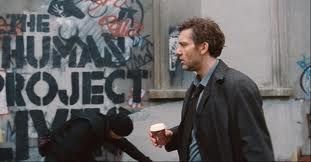
Take Children of Men: A new-born child presses a claim for care upon anyone and everyone, no matter what their filial relation or otherwise to it might be. This is the point made by this powerful film, about a dystopian future in which there are no children being born: the meaning of the film’s superficially odd title (based by the way on a line in the bible) is that any children born are children of all of us, of men as well as women.


 The film charts the journey of its central protagonist from a situation of cynicism to a situation of total care for a new-born child that is ‘not his’. The film is thus a vivid and rich metaphor for the care we all must have for the future of humankind. The newborn baby in the film directly symbolises of course the whole of future humankind, the human adventure, the human project. All who come after us are the children of all women, and all men. That is what I think the title really means...

Thus: these films are not (unlike, say, video-games) escapist. They provide an illusion of escape. Actually, they return one: to oneself and to the world, to in fact our world-in-peril.


Ready to know it (as if) for the first time…

This is what I see in these films. But again, I believe it is to a greater or lesser extent, consciously or unconsciously, what many millions of others see too. I believe that I am tapping here into the reason for the vast popular success of (most of) these films. For that success can otherwise be somewhat hard to understand: As already noted, Lord of the Rings has multiple fairly obvious flaws, including a quite basic and fundamental plot flaw; Avatar can easily be seen as a predictable and just very shiny exercise in cheese, or as a predictable ‘anti-American’ rant. Many critics have responded to Avatar either from ‘the Left’ (with cynicism and a knowing superiority to such alleged sentimentalism, romanticism and superficiality, or even with silly allegations that the film is itself tacitly racist against indigenous peoples, against the disabled, etc.) or from ‘the Right’ (with anger against the attack within the film on cultural norms, on (American) militarism, etc.). It is the critics from ‘the Right’, who are if anything slightly closer to the truth, I think, despite themselves. Avatar is shocking, in the extent to which, when one experiences it closely, (when one experiences for instance that arrow transfixing and killing one’s American/military/racist/speciesist self (Col. Quaritch), so that the world can be saved, and so that in due course Jake can be fully reborn as a Na’vi) the journey it proposes and offers takes one far indeed from one’s comfort-zone. I think that the reason why the film has been found by so many millions to be emotionally compelling – as emotionally compelling as the Na’vi themselves are, in their general emotional healthiness and expressiveness – is the kind of line of understanding of the film that I am alluding to here. People find it compelling, because of the ‘journey’ it takes them on, because of the assumptions it puts into question, because of the way that it speaks to our condition as alienated from our planetary home and from each other. And this is why Avatar was banned in China; this is why it has inspired colourful protests against the apartheid wall in Palestine; why it is inspiring the activist work of the Radical Anthropology Group and so on.

The exact same is true of Lord of the Rings; the drastic plot-flaws and unbelievable nature of the narrative end up being pluses, not minuses. They are gentle tacit ‘alienation effects’ in roughly Brecht’s sense of that word. They enhance the experience of questing that the viewer vicariously has; the psychological journey that one is taken on, into oneself, into one’s courage and resources and faith in oneself, in others and in what Aragorn calls “this good Earth."

Evaluating for character-development, plausibility, etc. in movies such as Apocalypto, Lord of the Rings and Avatar is a complete mistake. That is not the kinds of films they are. They don’t really have characters (in the sense that a classic novel does) at all. They are myths. They have heroes' journeys, etc., and, relatedly, they have transformative effects. They are revelatory, 'therapeutic' works. That is why I think them philosophical, in spite of their appearance. Or rather: Their appearance of being non-philosophical is the very thing that enables them to be truly philosophical...

True, some of the narrative-pleasure of Lord of the Rings and (especially) Avatar comes from following what can reasonably be described as character-development in complex plot-settings. In fact, utterly crucial to these films is the audience taking a vicarious transformational journey with the heroes: Jake’s persona by the end of the film is profoundly different from what it was at the start. I am not of course denying any of this; I am suggesting that this ‘character-development’ is not the kind of thing one finds in the world of the classic novel: it is not defined by its quiddities and specificities. On the contrary: It is defined by its universal resonance. What are developed are not so much characters as great mythic ciphers – ciphers, ultimately, for the persona of the viewer themselves.

Some films then precisely don’t have 'characters', and are all the stronger for that. For instance, in Lord of the Rings, it is crucial to realise that Frodo, Aragorn and Gandalf are all essentially the same 'character'. They are 3 versions of the same arc. That's not a criticism, it is an understanding.

These films’ appearance fools one into thinking that they cannot be deep. And so they creep up on you, with an ecological depth and a cultural critique that literally astonishes. I am referring for instance to the way in which Apocalypto shocks one to the core at the end: one suddenly realises that the film is not about a bunch of human-sacrificing savages running a barbarian empire: it is about us. We have been watching a culture that we looked down upon as oppressive imperial eco-destructors: only to find with a shock of recognition that Barbarians are us. A complete process of rethinking is then necessarily undergone, and the film watched the second time around is completely different from the fast time.

Consider in this connection the following remark from John Gray’s perceptive new book, The Silence of Animals (Penguin 2013, p.9): “[B]arbarism is not a primitive form of life, Conrad is intimating [in Heart of Darkness; the point is famously riffed on by Apocalypse Now, whose title, I suggest, points forward to that of Mel Gibson’s movie], but a pathological development of civilisation." Barbarism is not what precedes civilisation: it is what happens as a civilisation becomes decadent, and/or after it collapses. The point is also explored in Michel Henri’s book, Barbarism, and in Coetzee’s Waiting for the Barbarians (on which, if interested, see my 2011 review of Mulhall’s book on Coetzee, in MIND). But isn’t it wonderful to see it sprung on us in a novel and shocking way in a popular film?

Notice by the way the clear resemblance between these Mayan temples in Apocalypto and the border-wall (keeping out the ‘barbarian, monstrous’ south from the ‘home of the brave’) in the film Monsters - a wall that the protagonists see while standing amidst the overgrown ruins of an ancient Mayan temple. It’s not a coincidental one, in my view. Who are the monsters, who are the barbarians? This is the uncomfortable question thrust upon them by these films.


Some would nevertheless argue that popular Hollywood films with their action-sequences and loud soundtracks cannot be anything other than simplistic propagandistic ‘message’ films. I don't agree that an apparently-bombastic soundtrack is a sign of a film being a propagandistic film. I think those who say so have missed one of my central points about Lord of the Rings and Apocalypto (and Avatar): I think that these films work by pursuing what Cora Diamond (in relation to Wittgenstein’s Tractatus) calls 'an indirect method'. They precisely to appear to be crude, by virtue of having bombastic soundtracks etc. . That is how they then secretly work their magic. Their surface crudity is the vehicle for them to be able to do something deeper. Precisely in encouraging one to think that they aren't deep, they carve out a space for depth. In the case of Lord of the Rings: a film about psychotic madness etc. precisely needs to appear to be a film that is about a real-life epic struggle. (See my piece on the film here for more on this point). In the case of Apocalypto: the ride of the long chase in the latter half of the film slows down the process in one of realising that the film is actually not about a high speed chase in the Amazon - it is about you (us), about our culture. We should note furthermore that Avatar was successful, whereas other 3-D films with more dramatic and 'bombastic' effects have failed. I am offering a reason(s) why.

In this article I have invoked broadly-Wittgensteinian themes to defend some major popular films against the criticisms usually crudely levelled at them. However, I hope that you the reader don't get from this the wrong impression: I am by no means arguing that only these films are any good! Nothing of the sort! I am a big fan for instance of Eisenstein. I think that Werner Herzog's Grizzly Man is a deep ecologically-interested work; I am a huge fan of Herzog. I teach on these people, and on Bergman, Resnais, Von Trier, and Malick, etc.. I accept that often it is more obvious that what I am saying in this article is true of those film-makers than it is of Gibson, Jackson, Cameron, etc. . ‘Art-films’ often/generally are more essentially open to ‘interpretation’, demanding of ‘reading’ (Though the scare-quotes are advised: the terrible danger of such words is that it can once again sucker us into the heresy of paraphrase.)
What I dispute is only the crude 'high' vs. 'low' culture dichotomy and the concomitant very silly reductivist 'logic of commerce' point ('If it makes big money then it can't be any good!') that I believe sadly makes it impossible for many students/people from being able to say "I see you" to Avatar, The Lord of the Rings, Apocalypto. These films too, I am suggesting, necessarily involve the viewer, are not merely ‘morals’ wrapped in a shiny package. They too co-perform something; they too philosophise… The difference between them and the ‘art-films’ one is encouraged to look down one’s nose from is only one of degree, not of kind, I am saying.

A final substantive point: Avatar, like a number of other major philosophical films, places centrally in itself the metaphor of awakening from sleep, from dream. Now: Neither in a dream (unless it be a shared dream - think Inception!) nor in spectatorship (which has been the traditional model of philosophy (See for instance John Dewey's critique of this in The Quest for Certainty, Minton Balch and Company, 1929) - and of film-viewing (is this partly why philosophy and film have been so well-suited to each other? That both have usually been thought of as an essentially armchair activities? If so, this I think reflects badly on both)) does one encounter real others. One doesn't encounter anything more than the kind of thing that the killer Dollarhyde dreams of, in Mann’s superb movie Manhunter: oneself, glorious, reflected back at one, instead of the eyes of another. This postulation of the other only as a device to mirror the alleged glory of the self is a nightmare of egoism/solipsism:



How can it be avoided? Simple: by taking the risk, the leap of faith, necessary in actually encountering others. In meeting real, other people. This is how film can be therapeutic/transformative: by engaging one in a personal encounter which is also a shared encounter (This is one reason why, once more, it is important that we still generally see films in cinemas); by vicariously and then really throwing one into the world. This is the 'point'/task, I claim, of many of the films that I have here praised. And we can see it clearly also in Blade Runner and Inception (and Wings of Desire) and more through a glass darkly in Memento (and Manhunter). Look for it clearly (though not without great difficulty) also in Hiroshima Mon Amour, and even in Last Year at Marienbad. Other films, besides those mentioned above, which in my view clearly have this engaging therapeutic intent include Monsters (on which see Phil Hutchinson’s masterful thinkingfilm piece), District 9, Never Let Me Go, Melancholia, Collateral, 2001, and the films of Terrence Malick. Films of ‘high’ and ‘low’ culture both.

These films that I have mentioned here in this piece, indiscriminately popular and ‘art house’ works, are those that I think offer the best opportunity for broadly Wittgensteinian thinking on film. Some of them, I (along with thinkingfilmcollective colleagues) will be writing on more in the next few years. These are exciting times, for thinking film as philosophy…

________________________________________________


[N.B. A longer version of this article will be appearing in a special issue of the Al-Mukhatabat philosophy journal. So comments to help improve it are especially welcome! Thanks to various colleagues for comments already, including especially Peter Kramer and Vincent Gaine, and to Ruth Makoff for editorial assistance.]      

 
http://thinkingfilmcollective.blogspot.co.uk/

10 Greatest Ideas in the History of Science | Think Tank | Big Think

Evo2_2210436b

While science often moves forward in awkward leaps and bounds, Peter Atkins compiled a list of 10 concepts that are considered "so rock solid, that it is difficult to imagine them ever being replaced with something better." So our friends at RealClearScience's Newton blog write about Atkins's 2003 book, Galileo's Finger: The Ten Great Ideas of Science. While Atkins's picks might be incredibly worthy ones, many are also a bit hard to comprehend, so a guide to these concepts can be found on the Newton blog here, and are summarized briefly below. 

The 10 Greatest Ideas in the History of Science:

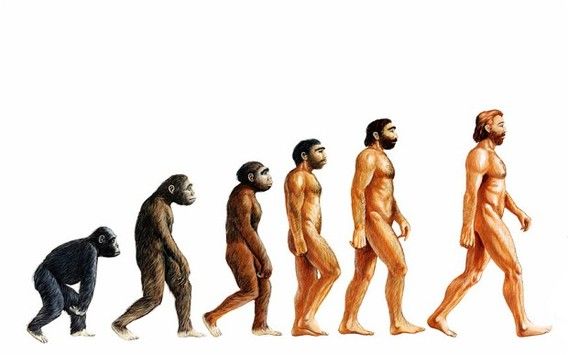
1. Evolution Occurs by Natural Selection


"The power of evolution comes from its ability to explain both the unity and diversity of life; in other words, the theory describes how similarities and differences between species arise by descent from a universal common ancestor."

Read more here

2. DNA Encodes Heritable Information

"It wasn't until 1952 that scientists determined that DNA was the molecule responsible for transmitting heritable information."

Read more here

3. Energy Is Conserved

"All the energy that currently exists in the universe is all that ever has been and all that ever will be."

Read more here

4. Entropy: Universe Tends Toward Disorder

"Entropy is sort of like Murphy's Law applied to the entire universe."

Read more here

5. Matter Is Made of Atoms

"What are atoms? Mostly empty space, actually. That means you are mostly empty space, as well."

Read more here

6. Symmetry Quantifies Beauty

"The most beautiful human faces are also the most symmetrical. As it turns out, the universe is riddled with symmetry, or the lack thereof."

Read more here

7. Classical Mechanics Fails to Describe Small Particles

"Imagine a hot stove: It first starts out red, then turns white as it gets hotter. Classical physics was incapable of explaining this."

Read more here

8. The Universe Is Expanding

"Not only is the universe expanding, its rate of expansion appears to be accelerating due to dark energy. And the further away an object is from Earth, the faster it is accelerating away from us."

Read more here

9. Spacetime Is Curved by Matter

"Every time you use your smartphone to succesfully find the local Starbucks, give thanks to Albert Einstein."

Read more here

10. Mathematics Is the Limit of Reason

"Though it is the language of science, the truth is that mathematics is built upon a cracked foundation."

Read more here

More from the Big Idea for Saturday, June 29 2013

We've come a long way from the days when ideas lived in particular cities, radiating outward via word of mouth or the hand-calligraphed codex of a specific philosopher. Almost as quickly as our br... Read More…

http://bigthink.com/think-tank/10-greatest-ideas-in-the-history-of-science?utm_source=feedburner&utm_medium=feed&utm_campaign=Feed%3A+bigthink%2Fblogs%2Fthink-tank+%28Think+Tank%29

Interview with Paul Socken, Editor of "Why Read Literature in the Digital Age?" | Critical Margins

Digital Reading

Interview with Paul Socken, Editor of “Why Read Literature in the Digital Age?"

Share This


Anyone who cares about literature and the act of reading should read the collection of essays, The Edge of the Precipice Why Read Literature in the Digital Age? The book’s contributions run the gamut from distress to sangfroid about the future of reading, culture and the development of the individual intellect in the age of the Internet. Paul Socken is the editor of this collection, and I asked him some questions about the book’s impact on the future of reading.


Thank you for agreeing to this interview, Paul. First of all, would you please tell us the origins of the phrase, “The Edge of the Precipice" and why you chose it as part of the title of your book?

The edge of the precipice is a phrase taken from a short story by F. Scott Fitzgerald in which he invites the reader to join him at “the edge of the precipice" where he will read him a story.

Why the edge of the precipice? Presumably, as I suggest in my introduction, because the literary exercise is at once exhilarating, full of adventure and the possibility of viewing new perspectives and vistas, but also dangerous in that one may see the world and life differently and be challenged in one’s fundamental thoughts and beliefs. I think the phrase powerfully sums up the excitement and opportunity that literature affords.

How did you go about choosing your contributors?

I knew some people personally whom I knew would be interested and would write beautifully on the topic. For others, I consulted what was then a new publication from Oxford on the history of publishing. I found extraordinary essays there and invited some of the contributors to join this project. My goal was to assemble a group of people with different kinds of experience from all over the world — academics, editors, writers, philosophers, archivists and librarians – who would provide a broad range of opinion. I asked them for personal essays based on their experience, not an academic treatise, about the importance of reading in the 21st century’s digital age.

Digital Reading

I found the essay, “Why I Read War and Peace on a Kindle (and Bought the Book When I Was Done)" by Michael Austin quite fascinating because I have “absorbed" War and Peace but never “read" it. I listened to it around 20 years ago on cassette tapes from the Books On Tape. As I recall, there were 44 or so tapes. I listened to the book over perhaps a year. What I found fascinating in Austin’s account is that after he read the novel on his Kindle he felt compelled to buy a paper copy of the book as a tangible token of both the pleasure he had found in reading it and of his sense of accomplishment in having tackled one of the monuments of literature.

Austin says, “…the two most endangered aspects of what we now call “reading" are solitude and concentration." But don’t Kindles and other e-readers plunge people into those very things just as much as print books do? Certainly, the passengers I have sat next to on airplanes seem just as absorbed in their Kindles as I am with my print magazine. Good writing is good writing isn’t it? Is the mode via which we read it all that important?

I was very taken with Austin’s piece because it seems to bridge two generations. He fully acknowledges the usefulness and inevitability of the digital book and at the same time needed to have a physical copy. It’s almost as if the book didn’t really exist, as if his relationship with that particular work weren’t real, if he didn’t “possess" it as a book as well. I fully understand that mentality because I share it and I think a lot of readers will, as well. We don’t go from one technology to another, leaving the first behind. There is a transition and often both survive. TV didn’t replace movies or even radio. Austin’s point, I think, is well taken.

You ask if Kindles don’t plunge readers into the same things as print books do. Kindle, perhaps, because it’s an e-reader. It’s basically a digital book. However, Kindle Fire and other such devices aren’t. They give the reader, already seeing everything in a multiple screen universe, a lot of opportunity to be distracted, whereas serious reading requires uninterrupted time, concentration, and depth of thinking. That’s the concern of many of my contributors, and I share that feeling.

In his essay, “Reading in a Digital Age: Notes on Why the Novel and the Internet Are Opposites, and Why the Latter Both Undermines the Former and Makes It More Necessary" Sven Birkerts echoes Austin’s concerns that we are losing the ability to concentrate. Birkerts writes, “Concentration is no longer a given; it has to be strategized, fought for." But I kept wondering if there was not something rather alarmist and self-indulgent in the concern of both men about what they seem to regard as the effrontery of the 21st century to intrude into their own neuro make-ups. Haven’t we heard all this before? Every new medium is predicted to presage the downfall of civilization. But this time, the doomsayers are glomming onto neuroscience to support their position that pretty soon we will all become stimuli-seeking airheads. Do you agree with Austin and Birkerts that the neurocircuitry of humankind is being fundamentally altered to the detriment of our collective capacity for contemplation? Couldn’t it be the case that we are simply evolving away from a single track focus on overly long narratives of little relevance to our own time?

You ask about Birkerts’s and Austin’s alarmist tone, as if the digital age presaged the end of civilisation. As writers, they are writing from a place of deep concern, but I don’t read them as overreacting. They are questioning the direction we are going and raising legitimate issues. As for the brain and its neurons, I have no idea and I doubt anyone writing on that topic really knows much about it either. What I do know from my teaching at the university level for 37 years is that there was a marked difference over time in the ability of the student to concentrate and to cope with the same amount of material that had previously been considered normal. My observations are echoed by many colleagues in different disciplines and constituted one of the reasons for my thinking of putting this collection together.

In his contribution to the book, “Solitary Reading in an Age of Compulsory Sharing" Drew Nelles writes, “Facebook is altering the way we read, and the way we share what we read." Do you agree with that?

I am a generation older than Nelles, so when I read this passage from his essay, “Do you want all your reading to be mediated by so few corporations?" I thought, “No—and it is not." I was born in 1963 and grew up in a time when big media dominated America far more than they do today. We got our news from a handful of networks. There are far more voices on the media landscape now. Corporations have been part of the North American cultural landscape for a good century or more. Do you agree are with Nelles here, “By forcing you to socialize your online life, these tech giants also force you to as unpaid ambassadors for their services." But who is really being forced—and one big company can help average people beard another, as some corporations have learned with bad PR days on Twitter. Is there really so much compulsory sharing?

You make a good point when you challenge Nelles and point out that we have many voices today rather than a few networks, for example, dominating the airwaves. However, although there is a great deal of information from different sources, many of those sources are themselves giant corporate empires with far more intrusive power than has ever been the case in the past, whether that power is obvious or not. Like the other writers in the collection, Nelles is forcefully presenting a legitimate point of view for the thoughtful reader to consider.

I admire many of the contributors to the book for their willingness to straightforwardly argue for the value of the book as a printed medium. But still I wondered … For example, in his essay, “Physical and Philosophical Approaches A World without Books?" Vincent Giroud says, “…for anything one reads—and you don’t read a dictionary unless you happen to be one of its editors—books remain irreplaceable." Anything? What about the growing number of digital humanities projects that have never been in printed form? And do we really get anything less out of huge editions of correspondence of Victorian political or literary figures by reading them online rather than in unwieldy printed volumes (if you could afford them or happen to live near and have privileges are a large academic library)?

You’re right, of course, that digital humanities projects are wonderful contributions to our culture and that reading Victorian literature or poetry online can be greatly moving experiences. But I thought that, of all the contributors, Giroud, as former curator of rare manuscripts at Yale, was especially well qualified to write about the special place of printed books in the history of scholarship. His long, professional history with the editions of printed works was a revelation to me. I had not before thought of the importance of first, second, third and fourth editions in quite that way before. I realized the importance of the original texts and the loss incurred by going completely digital by reading his essay and thought of it as one of the highlights of the volume.

Like Michael Austin and Vincent Giroud, Alberto Manguel seems very pro-printed book as opposed to digital text. In his essay, “The End of Reading," Manguel says, “Context, material support, the physical history and experience of a text are part of the text, as much as its vocabulary and its music. In the most literal sense, matter is not immaterial." But again, aren’t these men arguing for connoisseurship not necessarily a love of literature per se? Can’t I just listen to a volunteer-read version of James’ The Golden Bowl courtesy of LibriVox, benefit from James’ prose read competently enough and go on to the next audio book? Do I need to caress and collect pricey texts? Does a love of “literature" ever slide into snobbish consumerism?

I don’t think that Alberto Manguel is suggesting that literature can be appreciated in only one way, what you call “snobbish consumerism," but he does take a highly personal approach which reflects his own experience. His contribution is included in a part of the book titled “Poetic Readings," readings that are individualistic and deeply personal.

He has some reflections that are gems, such as “We know that every book holds within it all its possible readings, past present and future…" and his comment on reading Cervantes is striking: “…my own Don Quixotes, the ones that correspond to each of my several readings, the ones invented by my memory and edited by my oblivion, can find a place only in the library of the mind". I wanted good arguments in the book but can never resist meaningful and beautifully expressed insights, and I think Alberto Manguel is one of the masters.

In sharp contrast to the fierce devotion to the printed book of Austin, Giroud, and Manguel is the jaunty pragmatism on display in “Fragments from an Entirely Subjective Story of Reading," by Lori Saint-Martin, who says, “Books are heavy and cumbersome, their content is fixed, they cannot be updated. So, online encyclopedia, dictionaries, works of reference in general. Still books, but in another format." Later in her essay she says, “…an incompatibility between literature and a digital age? I don’t see it. Why choose?" She doesn’t seem at all worried by the dire prognostications of some in neuroscience of imminent global cognitive catastrophe. Where do you fall, Paul, on this spectrum among your contributors?

After your comments on Lori Saint-Martin’s wonderful contribution, you ask where I stand on the spectrum of printed book versus digital universe. I would say that I agree largely with Lori. As I mentioned earlier, I have grave concerns about the possible losses in shifting to the digital world. My contributors excellently outline those – not having a variety of editions as well as fragmented concentration and other issues. However, the one will not entirely erase the other. As long as we have both, then we will have the two worlds interacting and readers will have some choice and some decisions to make. They may be like Austin who wants to read on his Kindle and buy the printed book or like Saint-Martin who is entirely unconcerned by the format.  They may be like Katia Grubisic who dismisses e-books as inferior to the “real thing." The digital world is here and we must deal with it. I just want readers and the general public to be aware of the benefits and the problems.

The book seems to sometimes to equate “literature" with “pre-1950 novel almost certainly written by a white male." Am I mischaracterizing things there? Poetry does make appearances in the book, but most of the poets quoted or referred to are male.

You point out that there is little discussion of poetry and that much of the literature mentioned is the pre-1950s novel. That’s true. I didn’t have any preconceived notions once I chose my contributors and established the general parameters. Perhaps I should have asked them to think about poetry or contemporary works, but I didn’t.

Whom do you see as the ideal reader of this book? Do you hope that technologists will be one of its main audiences? Would you want Jeff Bezos to read it? People with the authority to allocate money to humanities departments (e.g., university administrators)?

I hope the book will find readers well beyond the academy. I conceived of this as a book for the general public. I wanted to start a discussion about the role of literature in a society that is clearly concerned about jobs and advocating for immediate, concrete, results-oriented education. My conviction throughout my career was that I was providing my students, by teaching them language and literature, important tools to assist them as educated citizens and that would be ultimately useful to them in whatever work they would undertake.

Finally, given that part of your title comes from F. Scott Fitzgerald, how do you think he (who was quite a celebrity in his early years) might have fared in our celebrity-obsessed culture? He didn’t seem to have liked the kind of solitude so many of your contributors (e.g., Nelles) laud and yet he did fairly well in the great literature production department. Who among contemporary writers would you say is destined to rank as a literary giant or is the age of giants no more?

As you mention, we live in a celebrity culture. It was wonderful to see the reaction to Alice Munro winning the Nobel Prize for literature. To me, it meant that celebrity isn’t limited to sports figures and movie and television stars. The coverage she has received and the letters to the editors to all the newspapers are testimonials to the importance of literature in our supposedly utilitarian and pragmatic society.

As a final comment, I would point out to the readers of Critical Margins that there are other contributors to this volume whose essays are illuminating and thought-provoking. I refer to Leonard Rosmarin for his entertaining personal experience, Mark Kingwell’s philosophical approach, J. Hillis Miller’s paean to poetry, Keith Oatley’s psychological reading, Ekaterina Rogatchevskaia of the British Library and South Africa’s Gerhard van der Linde for a global perspective.

Thank you for your time.

Related articles


Like this:


About Hope Leman

Hope Leman is a research information technologist and a 2009 graduate of the Master of Library and Information Science program at the University of Pittsburgh. She is extremely interested in the subjects of crowdfunding, publishing and all things digital. She can be followed on Twitter.

http://criticalmargins.com/2013/10/16/interview-paul-socken-editor-read-literature-digital-age/?utm_source=feedburner&utm_medium=feed&utm_campaign=Feed%3A+CriticalMargins+%28Critical+Margins%29

Myers Briggs Test | MBTI Personality Types

Try this out...


Myers Briggs Test * What is your Myers-Briggs Personality Type?
Exploring Myers-Briggs Personality Type

So what do all those cryptic MBTI code letters mean?

Before taking our informal online - free - Myers Briggs Personality Test ("click here" to take our Cognitive Style Inventory) to assist in verifying your Myers Briggs personality type score . . . know that the best way to understand your personality or psychological type is to take an official MBTI ® ( Myers Briggs Type Indicator ) instrument from a professional who has met the standards necessary to be "qualified" to administer the "test." An excellent resource for "qualified" persons is the Association for Psychological Type. Through their web site at www.aptinternational.org you can learn about APT chapters and members in your area.


Ads by Google

Background of the MBTI ®
Over the sixty five plus years since its inception in 1943, the MBTI or Myers-Briggs Type Indicator ® has evolved and been perfected through continual test research and development of ever more accurate questions. Many, many millions of people have taken the test (actually the Indicator is an inventory or psychological instrument rather than a test - as a test suggests right and wrong answers. All answer choices in the MBTI are equally desired). The MBTI research data base is huge. The subtle enhancements to recently released "M" edition of the inventory were the product of a landmark normative study involving thousands of people and over two years of work by a team of experts in the field of psychometrics (psychological testing).

Learn about the MBTI personality testSince it is considered a breach of professional ethics to administer an MBTI ® without person-to-person follow-up verification by a qualified practitioner, none of the free personality tests purporting to determine your MBTI or Myers Briggs Personality Type on the Web are the "real thing." The Web is replete with "inventories" that purport to measure personality types, psychological type or the 16 Myers Briggs   personality types (like the David Keirsey type-temperament indicator)! Besides only being approximations of the "real thing," I am aware of none that have met commonly accepted psychometric standards for reliability and validity. Bottom-line. While every inventory has room for improvement, the genuine MBTI ® is the "gold standard."

Recently, the instrument publisher, CPP, Inc. (formerly Consulting Psychologists Press), has developed an online system for administering and interpreting the MBTI ® called "MBTI ® Complete." This new system allows individuals to take the inventory online and get a professional interpretation. It also can be used by Qualified MBTI practitioners who use the online administration process as a supplement to their counseling or coaching practice. One source of practitioners trained and certified to use the MBTI, including official online versions, is the MBTI Master Practitioner Referral Network.

® MBTI, Myers-Briggs, Meyers Briggs, and Myers-Briggs Type Indicator are registered trademarks or trademarks of the Myers-Briggs Type Indicator Trust in the United States and other countries (aka meyers briggs, briggs myers or myer briggs).  

* While sometimes referred to as the Myers-Briggs Personality Test, the Briggs Myers personality test, Myers Briggs Test or the MBTI test, the MBTI ® is not a personality test but a personality inventory or instrument in which there are no right or wrong answers.

Introduction to the Cognitive Style Inventory
This modest self-scoring inventory is Not a substitute for taking an MBTI ®. It is simply an introduction to personality type or psychological type. We hope it whets your appetite for learning more about the Myers and Briggs model of personality development and its message of increased human understanding.

The Style Inventory will allow you to approximate what are your MBTI Type preferences. After determining your 4 Type letters, you can jump to a number of links we have provided to help you get acquainted with the characteristics and indicators of the 16 types and verify if your type, as determined by this "unscientific" survey, seems to "fit" or not.

- Links to Resources to Learn More about the MBTI ® and Personality Type

-- Ross Reinhold, INTJ

---COPYRIGHT NOTICE
© As the Cognitive Style Inventory is intended to be used on the Internet, linking to this page is permitted. However copying or reproducing this inventory, in whole or part, is prohibited without the express permission of the author.
Ross Reinhold - ross@personalitypathways.com

The Cognitive Style Inventory is NOT the (MBTI) Myers-Briggs Type Indicator. The exclusive publisher of the MBTI is CPP, Inc., a publishing conglomerate who authorizes and certifies professionals in the use of this instrument. The MBTI is not a Personality Test; it is an assessment instrument. Information on its use can be obtained at the website of the Myers & Briggs Foundation. Myers-Briggs Type Indicator, Myers Briggs, MBTI, the MBTI logo, Step I, Step II and Step III are trademarks or registered trademarks of the MBTI Trust, Inc.


Cognitive Style Inventory©
most recent revision 12/12/06 - Ross Reinhold, INTJ
www.PersonalityPathways.com

Determining one's natural Myers Briggs Personality Type is frequently complicated by our life-long learning experiences. The classic question is: " Am I this way because I learned it or is this just the way I am?"

In reviewing the comparisons in our inventory, you may find yourself drawn equally to opposing personality preference choices. In such cases I suggest you try to think back to how you were before the age of 12 or even younger if you can recall. The rationale for this suggestion is the fact that by the time we are 3 years old, the core of our cognitive organization is well-fixed. . . although the brain continues to allow some plasticity until puberty.

After the onset of puberty, our adult learning begins to overlay our core personality - which is when the blending of nature and nurture becomes more evident. For some people, this "learning" serves to strengthen what is already there, but with others it produces multiple faces to personality. Discovering or rediscovering this innate core of yourself is part of the journey of using personality types to enrich your life.

Each of the four questions of the CSI inventory has two parts. The first part is a general description of the preference choices. The second part is a list of paired statements. Use both parts to form your opinion on your more dominant preference.


Q1. Which is your most natural energy orientation?

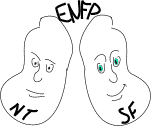
Every person has two faces. One is directed towards the OUTER world of activities, excitements, people, and things. The other is directed inward to the INNER world of thoughts, interests, ideas, and imagination.

While these are two different but complementary sides of our nature, most people have an innate preference towards energy from either the OUTER or the INNER world. Thus one of their faces, either the Extraverted (E) or Introverted (I), takes the lead in their personality development and plays a more dominant role in their behavior.

 Extraverted Characteristics

  • Act first, think/reflect later

  • Feel deprived when cutoff from interaction with the outside world

  • Usually open to and motivated by outside world of people and things

  • Enjoy wide variety and change in people relationships

Introverted Characteristics

  • Think/reflect first, then Act

  • Regularly require an amount of "private time" to recharge batteries

  • Motivated internally, mind is sometimes so active it is "closed" to outside world

  • Prefer one-to-one communication and relationships

Choose which best fits:  Extraversion (E)  Introversion (I)
 

Q2. Which way of Perceiving or understanding is most "automatic" or natural?

The Sensing (S) side of our brain notices the sights, sounds, smells and all the sensory details of the PRESENT. It categorizes, organizes, records and stores the specifics from the here and now. It is REALITY based, dealing with "what is." It also provides the specific details of memory & recollections from PAST events.

The Intuitive (N) side of our brain seeks to understand, interpret and form OVERALL patterns of all the information that is collected and records these patterns and relationships. It speculates on POSSIBILITIES, including looking into and forecasting the FUTURE. It is imaginative and conceptual.

While both kinds of perceiving are necessary and used by all people, each of us instinctively tends to favor one over the other.

 Sensing Characteristics

  • Mentally live in the Now, attending to present opportunities

  • Using common sense and creating practical solutions is automatic-instinctual

  • Memory recall is rich in detail of facts and past events

  • Best improvise from past experience

  • Like clear and concrete information; dislike guessing when facts are "fuzzy"

Intuitive Characteristics

  • Mentally live in the Future, attending to future possibilities

  • Using imagination and creating/inventing new possibilities is automatic-instinctual

  • Memory recall emphasizes patterns, contexts, and connections

  • Best improvise from theoretical understanding

  • Comfortable with ambiguous, fuzzy data and with guessing its meaning.

Choose which best fits:  Sensing (S)  iNtuition (N)
Q3. Which way of forming Judgments and making choices is most natural?

The Thinking (T) side of our brain analyzes information in a DETACHED, objective fashion. It operates from factual principles, deduces and forms conclusions systematically. It is our logical nature.

The Feeling (F) side of our brain forms conclusions in an ATTACHED and somewhat global manner, based on likes/dislikes, impact on others, and human and aesthetic values. It is our subjective nature.

While everyone uses both means of forming conclusions, each person has a natural bias towards one over the other so that when they give us conflicting directions - one side is the natural trump card or tiebreaker.

 Thinking Characteristics

  • Instinctively search for facts and logic in a decision situation.

  • Naturally notices tasks and work to be accomplished.

  • Easily able to provide an objective and critical analysis.

  • Accept conflict as a natural, normal part of relationships with people.

Feeling Characteristics

  • Instinctively employ personal feelings and impact on people in decision situations

  • Naturally sensitive to people needs and reactions.

  • Naturally seek consensus and popular opinions.

  • Unsettled by conflict; have almost a toxic reaction to disharmony.

Choose which best fits:  Thinking (T)  Feeling (F)

Q4. What is your "action orientation" towards the outside world?

All people use both judging (thinking and feeling) and perceiving (sensing and intuition) processes to store information, organize our thoughts, make decisions, take actions and manage our lives. Yet one of these processes (Judging or Perceiving) tends to take the lead in our relationship with the outside world . . . while the other governs our inner world.

A Judging (J) style approaches the outside world WITH A PLAN and is oriented towards organizing one's surroundings, being prepared, making decisions and reaching closure and completion.

A Perceiving (P) style takes the outside world AS IT COMES and is adopting and adapting, flexible, open-ended and receptive to new opportunities and changing game plans.

 Judging Characteristics

  • Plan many of the details in advance before moving into action.

  • Focus on task-related action; complete meaningful segments before moving on.

  • Work best and avoid stress when able to keep ahead of deadlines.

  • Naturally use targets, dates and standard routines to manage life.

Perceiving Characteristics

  • Comfortable moving into action without a plan; plan on-the-go.

  • Like to multitask, have variety, mix work and play.

  • Naturally tolerant of time pressure; work best close to the deadlines.

  • Instinctively avoid commitments which interfere with flexibility, freedom and variety

Choose which best fits:  Judging (J)  Perceiving (P)
http://www.personalitypathways.com/type_inventory.html

Sphinx Facts, Body, Breastplate, Schematics, Tunnels, Chambers, Enclosure Wall, - Crystalinks


Facts, Schematics, More


I am still working on the sphinxes....  A lot of work, but also (most of the time, FUN


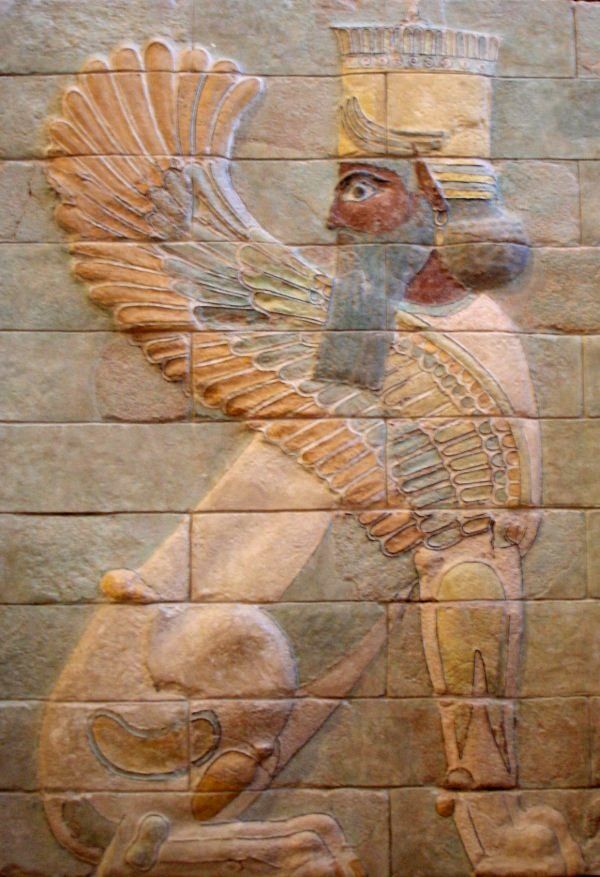
A Sphinx is a zoomorphic mythological figure which is depicted as a recumbent lion with a human head. It has its origins in sculpted figures of Old Kingdom Egypt, to which the ancient Greeks applied their own name for a female monster, the "strangler", an archaic figure of Greek mythology. Similar creatures appear throughout South and South-East Asia, and the sphinx enjoyed a major revival in European decorative art from the Renaissance onwards.


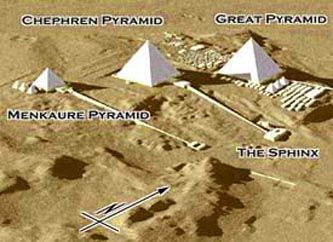
The Great Sphinx of Egypt, the largest and best known Sphinx, lies near the Great Pyramid in the Giza Valley Plateau, situated about six miles west of Cairo. It is the largest single sculpted statue in the world, carved from the bedrock of the plateau.

The Sphinx is oriented due east facing the rising sun near the 30th parallel, and may well be the oldest monument on the Giza Plateau since long-term water weathering has been found in the great pit in which it lays.

The Western name "Sphinx" was given to it in antiquity based on the legendary Greek creature with the body of a lion and the head of a woman, though Egyptian sphinxes have the head of a man. The ancient Greek term itself is postulated to be a corruption of the ancient Egyptian Shesep-ankh. This name was applied to royal statues in the Fourth Dynasty, though it came to be more specifically associated with the Great Sphinx in the New Kingdom.

In medieval texts, the names balhib and bilhaw referring to the Sphinx are attested, including Egyptian historian Maqrizi, which suggest Coptic constructions. The Egyptian Arabic name Abul-Hol, which translates as Father of Terror, came to be more widely used.

No one is certain when the Sphinx was built nor what it represents, though many theories about its origin and purpose have been noted. It is commonly believed that the Sphinx was built by ancient Egyptians in the 3rd millennium BC.

We do not known the name ancient Egyptians called the statue. It is referred to circa 1500 B.C.E. as Hor-em-akht - Horus in the Horizon, Bw-How Place of Horus and also as Ra-horakhty Ra of Two Horizons.

  • Horus - Hours - the Place Where Time Began
  • Horus - Horse - Horse Horsehead Nebula- Creation

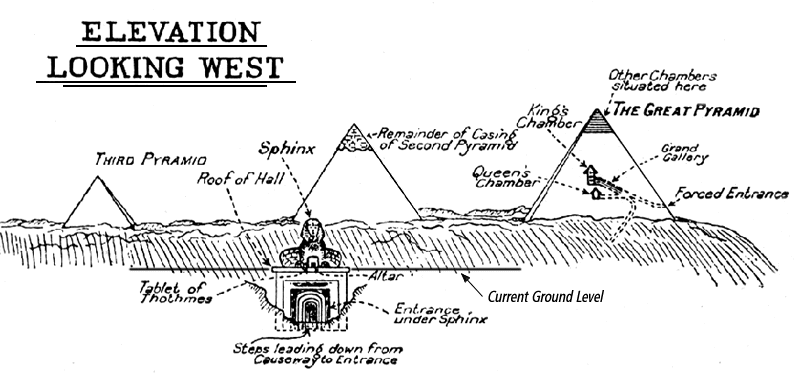
Carved out of the surrounding limestone bedrock, the Sphinx is 57 metres (260 feet) long, 6 m (20 ft) wide, and has a height of 20 m (65 ft), making it one of the largest single-stone statues in the world. Blocks of stone weighing upwards of 200 tons were quarried in the construction phase to build the adjoining Sphinx Temple.

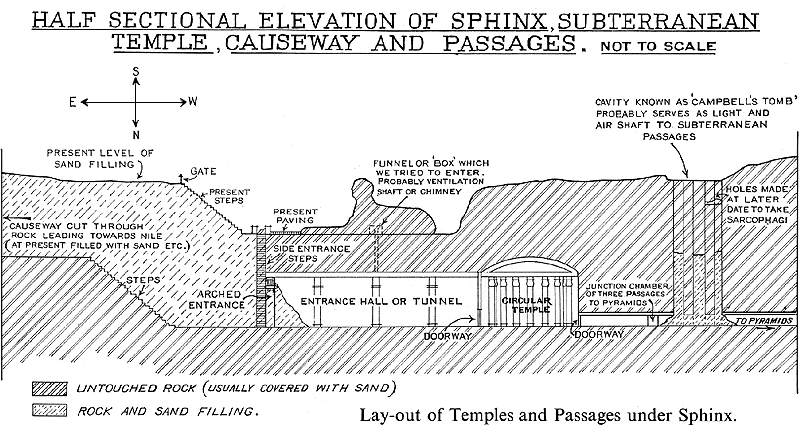
The Sphinx faces due east, with a small temple between its paws. The temple resembles the sun temples that were built later by the kings of the 5th Dynasty.

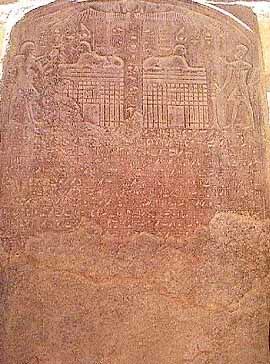
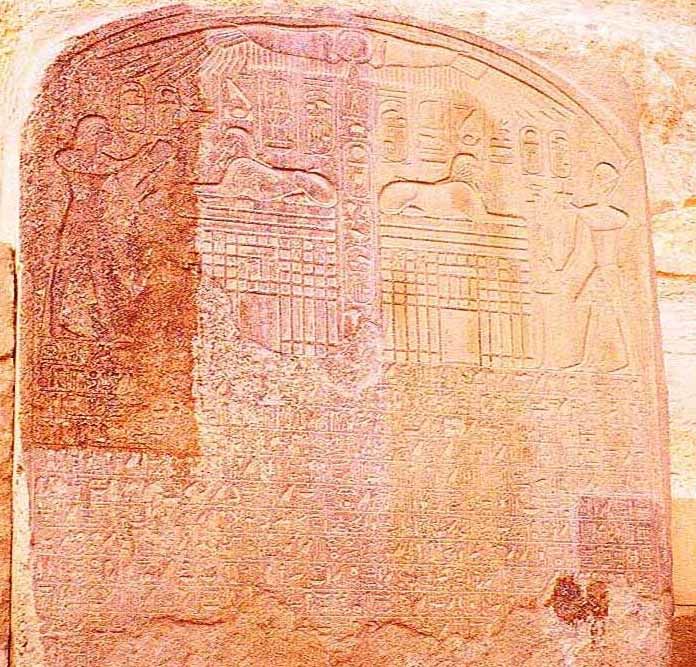
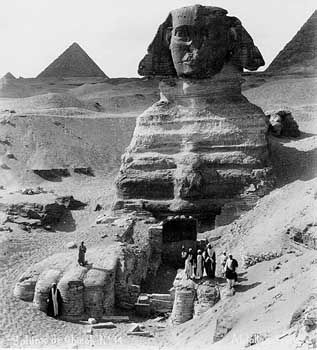
The first attempt to dig it out dates back to 1400 BC, when the young Tutmosis IV, falling asleep beneath the giant head, dreamt that he was promised the crown if he would only unbury the Sphinx. The young prince immediately formed an excavation party which, after much effort, managed to dig the front paws out. To commemorate this effort, Tutmosis IV had a granite stela known as the Dream Stela placed between the paws. Ramesses II may have also performed restoration work on the Sphinx.

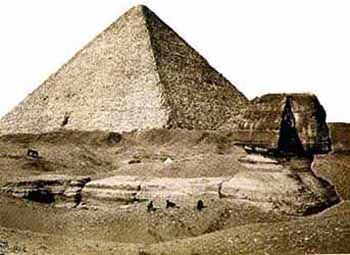
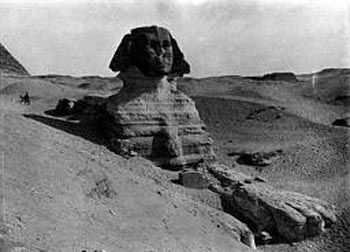
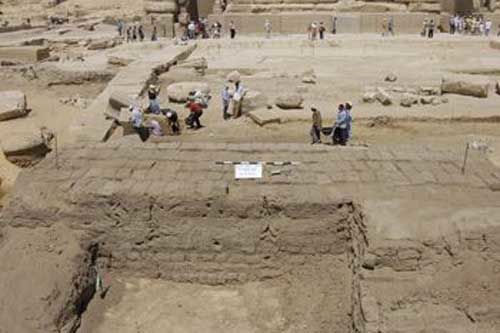
In 1817 the first modern dig, supervised by Captain Caviglia, uncovered the Sphinx's chest completely. The entirety of the Sphinx was finally dug out in 1925, to the great pleasure of its numerous visitors.

There are no inscriptions on, or in the Sphinx to indicate who built it.

The true origin and purpose of the Sphinx remains a mystery, and it is perhaps a puzzle which will never be fully solved. Despite its fundamental enigma, the image of the Sphinx remains in the mind of history as the keystone of ancient Egyptian civilization and a part of its religious beliefs.


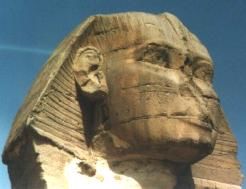
Missing Nose

The one-meter-wide nose on the face is missing. It has long been presumed that the nose had been broken off by a cannon ball fired by Napoleon's soldiers. However, sketches of the Sphinx by Frederick Lewis Norden made in 1737 and published in 1755 illustrate the Sphinx without a nose.

The Egyptian historian al-Maqrizi, writing in the fifteenth century, attributes the vandalism to Muhammad Sa'im al-Dahr, a Sufi fanatic from the khanqah of Sa'id al-Su'ada. In 1378, upon finding the Egyptian peasants making offerings to the Sphinx in the hope of increasing their harvest, Sa'im al-Dahr was so outraged that he destroyed the nose. Al-Maqrizi describes the Sphinx as the "Nile talisman" on which the locals believed the cycle of inundation depended.

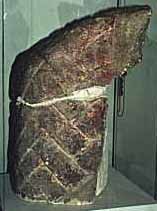
In addition to the lost nose, a ceremonial pharaonic beard is thought to have been attached, although this may have been added in later periods after the original construction. Egyptologist Rainer Stadelmann has posited that the rounded divine beard may not have existed in the Old or Middle Kingdoms, only being conceived of in the New Kingdom to identify the Sphinx with the god Horemakhet.

This may also relate to the later fashion of pharaohs, which was to wear a plaited beard of authority - a false beard (chin straps are actually visible on some statues), since Egyptian culture mandated that men be clean shaven. Pieces of this beard are today kept in the British Museum and the Egyptian Museum.


Head

The head of the Sphinx was altered many times by the Pharaohs therefore it is best remembered with the head of a king wearing his headdress and the body of a lion. Many believe that the original head was that of the lion and the Sphinx dates to the Age of Leo - 12,000 years ago.

Based on the current head, many researchers have concluded that the Sphinx was built by the Pharaoh Khafre - Chephren in the 4th Dynasty around 2500 BC.

Interestingly the features of the face of the Sphinx bear a far more striking resemblance to an older brother of Khafre, the Pharaoh Djedefre - Radjedef.

In 1996, a NY detective and expert in identification, took various measurements of the size, angles and proportions of the head and concluded that it did not match known representations of Khafre's face. There was a greater resemblance to Khafre's elder brother Djedefre.

Djedefre's short lived reign occurred just prior to the reign of Khafre. Unlike Khafre, Khafre's father, and later Khafre's brother Menkara, Djedefre did not construct his pyramid on the Giza plateau. Instead Djedefre built his pyramid at Abu Roash where it now lies badly damaged. Some believe that Khafre usurped the throne of Djedefre and then built his pyramid and Sphinx at Giza.

The sphinx has been repaired many times due to erosion by water and wind. Some people believe that the Sphinx was painted and was quite colorful. Since then, the nose and beard have been broken away.

A piece of the original beard

The nose was the unfortunate victim of target practice by the Turks in the Turkish period. It is often erroneously assumed that the nose was shot off by Napoleon's men, but 18th century drawings reveal that the nose was missing long before Napoleon's arrival. Traces of the original paint can still be seen only near one ear.


1858


1895

In 1905 the sand was cleared away to expose the full body of the Sphinx. The head has been replaced by several different heads - the original the head of a feline cat.

The most recent period of restoration began in 2006. The cement which had been used in earlier attempts at restoration was now found to be causing problems. The statue is mostly constructed of porous limestone, which allows the passage of air. Because cement is non-porous and rigid, changes in the basic proportions of the statue were found to be occurring.


Ethnicity of the Face of the Sphinx

Over the years, casual observers, as well as at least one forensic expert have characterized the face of the Sphinx as "Negroid". One of the earliest known descriptions of a "Negroid" Sphinx is recorded in the travel notes of French scholar Constantin-Fran�ois de Chasseb�uf, Comte de Volney, who visited in Egypt between 1783 and 1785. Volney described it as "typically Negro in all its features." Likewise, French novelist Gustave Flaubert traveled to Egypt in 1849 and recorded the following observation:


We stop before a Sphinx; it fixes us with a terrifying stare. Its eyes still seem full of life; the left side is stained white by bird-droppings (the tip of the Pyramid of Khephren has the same long white stains); it exactly faces the rising sun, its head is grey, ears very large and protruding like a negro's its neck is eroded; from the front it is seen in its entirety thanks to great hollow dug in the sand; the fact that the nose is missing increases the flat, negroid effect. Besides, it was certainly Ethiopian; the lips are thick. In 1992, the New York Times published an article reporting the findings of Frank Domingo, a senior forensics artist with the New York City Police Department who had traveled to Egypt to take exact measurements of the Sphinx's head. Domingo, credited with convening the first national gathering of forensic artists almost ten years earlier, generated a model of the head of the Sphinx both by hand and utilizing computer graphics, and determined that the Sphinx represented a person other than Khafra. Robert M. Schoch of Boston University further suggests that the face has "a distinctive 'African,' 'Nubian,' or 'Negroid' aspect which is lacking in the face of Khafra."

The New York Times subsequently published a letter to the editor submitted by orthodontist Sheldon Peck, who concurred with Domingo:


The analytical techniques�Detective Frank Domingo used on facial photographs are not unlike methods orthodontists and surgeons use to study facial disfigurements. From the right lateral tracing of the statue's worn profile a pattern of bimaxilliary prognathism is clearly detectable. This is an anatomical condition of forward development in both jaws, more frequently found in people of African ancestry than in those from Asian or Indo-European stock.


Body

The paws are 50 feet long (15m) while the entire length is 150 feet (45m).
The head is 30 (10m) feet long and 14 feet (4m) wide.
It is 200 feet long and 65 feet high.

The Sphinx has a tail which wraps around the right hind paw.
The paw has been restored in recent years.


Breastplate

The Sphinx has a breast plate between its front paws.

In the New Kingdom, the Sphinx became a symbol of kingship and many kings of this period built temples and stelae (Sphinx Breastplate tablets bearing inscriptions) in the area surrounding the statue. Amenhotep II built a mud-brick temple to the north-east of the Sphinx, and Rameses II, one of the ancient kingdom's most prolific builders, constructed an altar of granite between its paws. Ancient tablets also show images of worshippers presenting burnt offerings to the Sphinx.

There are many metaphors on the breastplate that following the formula for creation - separation in the physical - to ascension or resurrection of consciousness in the alchemy of time. The lions images, for example, facing in separate directions represent duality in the electromagnetic grids that form our consciousness experience.

In the New Kingdom, the Sphinx became a symbol of kingship and many kings of this period built temples and stelae (upright stone tablets bearing inscriptions) in the area surrounding the statue. Amenhotep II built a mud-brick temple to the north-east of the Sphinx, and Rameses II, one of the ancient kingdom's most prolific builders, constructed an altar of granite between its paws. Ancient tablets also show images of worshippers presenting burnt offerings to the Sphinx.


Schematics, Tunnels, and Chambers


Side doors lead to underground passageways.

Underground passageways and chambers in front and rear

Two passages were found in 1978 - one behind the head of the Sphinx and another on the tail. Far from leading to the Pyramids, however, these tunnels merely led downwards under the monument and were made during the past century by treasure-hunters.

During the past two centuries many have come to study and excavate the monument. These include French scholars accompanying Napoleon's army in 1798, Caviglia in 1816, H. Vyse in 1840, Mariette in 1853, Kamal and Daressy in 1909 and Baraize in 1926. It was Baraize who first began restoration work, by renovating the head using cement, and clearing the sand completely around the Sphinx.

Restoring the paws

Another problem is caused by the rising water table, which evaporates, leaving salts behind. These salts react with the limestone, causing it to become powdery and to crumble. Pollution from the nearby city of Cairo, together with heat, wind, sand and humidity are all agents in the monument's slow process of disintegration.

In 1982, stones were lost from the north paw and in 1988 a large stone fell from the Sphinx's shoulder. From 1989 onwards, the restoration project entered a more enlightened phase, with more thought being given to the monument's long-term preservation in its original form.

The restoration project was planned in three stages: first, to restore the southern side, next the northern side and the chest and lastly, to protect the whole monument from the ravages of the elements.

The large old stones and cement were removed from the southern side and replaced with new stones from a quarry at Helwan, which contains rock consistent with the limestone of the original structure. Mortar made of lime and sand replaced the cement as a fixative, and the chest was protected by a limestone course.

The Institute of Astronomy and Geophysics at Helwan conducted important studies on the level of the water table, and this has been found to be seven metres below the base of the monument. An electronic weather station nearby at the Getty Institute now records wind, heat and humidity, and a study of the bedrock under the Sphinx has been undertaken by the Engineering Faculty at Cairo University.


Enclosure Wall Found


Newly Discovered Walls Buffered Sphinx from Egypt's Sand
 
Live Science - November 3, 2010

A routine excavation has uncovered ancient walls surrounding the Great Sphinx of Giza, Egypt's Supreme Council of Antiquities (SCA) announced. The walls were likely built to protect the Sphinx from blowing sand, said SCA Secretary-General Zahi Hawass, who is overseeing the excavation.

During routine digging, SCA researchers found two segments of mud wall on the Giza Plateau, where the pyramids of Giza and the Sphinx stand. Both walls stand just under 3 feet (1 meter). One runs north-south and is 282 feet (86 meters) long, while the other runs east-west and is 151 feet (46 m) long. The walls are part of a larger enclosure previously found north of the Sphinx. As told in ancient Egyptian texts, King Thutmose IV once went on a hunting trip near the Sphinx.

After the trip, he dreamt that the Sphinx wanted him to clear the sand surrounding its body. According to Thutmose, the Sphinx promised that if he restored the statue, he'd become king of Egypt. So Thutmose had the sand cleared and built a wall to preserve the Sphinx. Until now, researchers thought the wall was only built on the northern side of the Sphinx. The new finding disproves that theory.

The researchers also found a third wall to the east of the temple of King Khafre, the builder of the second-largest pyramid in Giza and the likely builder of the Sphinx. According to Hawass, the wall may be part of the settlement that grew up around King Khafre's pyramid after the monarch's death around 2532 B.C. In this village, priests and officials oversaw the mortuary cult of the dead king.

Khafre's mortuary cult remained strong until the end of Egypt's Old Kingdom around 2143 to 2134 B.C. After that, initial excavations suggest the village was abandoned, said Essam Shehab, the supervisor of the Khafre's valley temple excavation. Excavations continue on the Thutmose IV enclosure wall, according to the SCA. The archeologists are keeping an eye out for other secrets still hidden in the sand.


Sphinx Wikipedia

  Sphinx Google Videos


In the News ...


Pharaoh's Sphinx Paws Found in Israel   Live Science - July 9, 2013

Archaeologists digging in Israel say they have made an unexpected find: the feet of an Egyptian sphinx linked to a pyramid-building pharaoh. The fragment of the statue's front legs was found in Hazor, a UNESCO World Heritage Site just north of the Sea of Galilee. Between the paws is a hieroglyphic inscription with the name of king Menkaure, sometimes called Mycerinus, who ruled Egypt during the Old Kingdom more than 4,000 years ago and built one of the great Giza pyramids. Researchers don't believe Egypt had a relationship with Israel during Menkaure's reign. They think it's more likely that the sphinx was brought to Israel later on, during the second millennium B.C.

Sphinx paws tied to Egyptian pharaoh dug up in Israel   MSNBC - July 9, 2013
This sphinx fragment was found by archaeologists with the Hebrew University of Jerusalem during excavations at Hazor. Archaeologists digging in Israel say they have made an unexpected find: the feet of an Egyptian sphinx linked to a pyramid-building pharaoh. The fragment of the statue's front legs was found in Hazor, a UNESCO World Heritage Site just north of the Sea of Galilee. Between the paws is a hieroglyphic inscription with the name of King Menkaure, sometimes called Mycerinus, who ruled Egypt during the Old Kingdom more than 4,000 years ago and built one of the great Giza pyramids. Researchers don't believe Egypt had a relationship with Israel during Menkaure's reign. They think it's more likely that the sphinx was brought to Israel later on, during the second millennium B.C.


SPHINX INDEX


ShareThis


GREAT PYRAMID COMPLEX


ANCIENT EGYPT INDEX


PYRAMIDS OF EGYPT INDEX


SACRED PLACES AND TEACHINGS INDEX


ANCIENT CIVILIZATIONS INDEX


ALPHABETICAL INDEX OF ALL FILES


CRYSTALINKS HOME PAGE


PSYCHIC READING WITH ELLIE


2012 THE ALCHEMY OF TIME


http://www.crystalinks.com/sphinxfacts.html

Welcome to Postach.io!

Postach.io is the blogging platform that's powered by your Evernote documents.

Creating a Post

Postach.io creates blog posts and pages from your notes. To create a post, write a note and tag it as "published" in this notebook. Then click the "Sync" button. Bam! Your note is published on your site, just like that!

Creating a Page

Creating a page works the same, except you add an additional tag "page". This tells Postach.io to create your note as page instead of a post.

Editing a Post

Updating a note is just as easy. Try making a change to this note, and click the "Sync" button. Visit your site, and you'll see its been updated.

Deleting a Post

To remove a note from your site, simply remove the "published" tag and re-sync. You could also delete the note itself. Its that easy!

How do I change the profile photo on my site?

To upload a custom profile photo, create a note in your sites notebook and add the image you'd like to use. Tag the note with "avatar" and sync Evernote. Change the photo in that same note anytime you'd like to update your photo. Thats it! For those who use Gravatar, we support that by default too.

Creating Additional Sites?

To create a site, click the "Create New Site" button above. You'll be taken to Evernote to authenticate your account. You'll then be able to select an Evernote notebook, a unique subdomain along with other details such as author, twitter username and Google analytics code.

How can I format the style of my posts and pages?

There are several ways to format your notes. The easiest is to use the Evernote browser version. Although Evernote has a desktop and mobile version, their browser app has more formatting options for fonts, resizing and aligning images and inserting other elements. The second option is to use Markdown. This is basically a way of using regular text elements to format your notes. You can learn more about Markdown here. The last, and more advanced approach is to use HTML directly. Postach.io supports basic HTML elements and styles.

How can I add comments to my blog posts?

Postach.io uses Disqus for comments. Its a widely used and excellent tool for adding threaded comments to your site quickly. You'll need to create an account, which is free, to start using it.

I still have questions!

We'd be glad to help! Hit us up by clicking the "?" icon at the bottom right hand of your Postach.io screen. Alternatively we post lots of tutorials and tips on our blog and Facebook Group.

Example Postach.io Blogs

Postach.io can be used to create many variations of blogs and documentation sites! Here's some ideas to get you started.

  • A tumble blog of your life and adventures.
  • The internet needs more funny cat photos. Go!
  • As an educator you can use it for teaching.
  • Start a food blog of your favourite places to eat, with a short review.
  • Documentation for your product or app.
  • Create a link blog of interesting articles.
  • Share your notebook with friends to make a collaborative wiki.
Moving Forward

We're really excited about Postach.io and are happy you've decided to join us for the ride! If you have any suggestions, questions or feedback, we're all ears! We want to make this thing awesome! We can't do it without you.

Don't forget to follow us on Twitter(@PostachioApp) or Facebook(facebook.com/PostachioApp)!